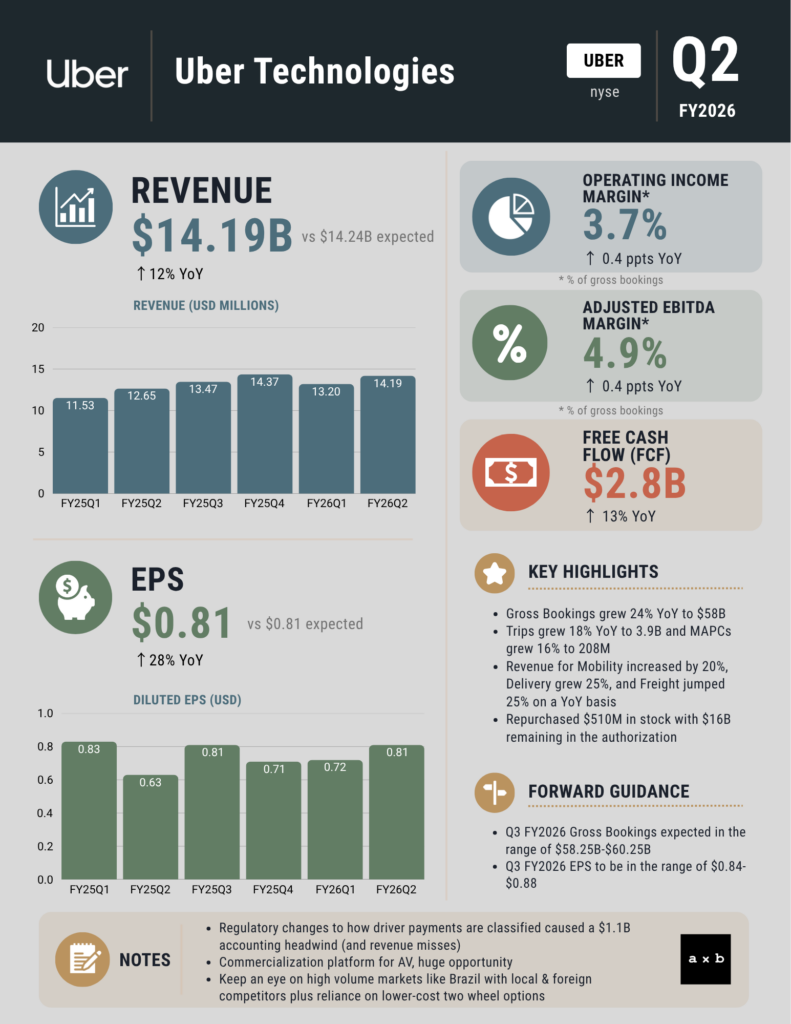

Uber Technologies (NYSE:UBER) delivered solid operational volume for Q2, though reported revenue fell slightly short of expectations due to regulatory and business model shifts in the UK. Total Gross Bookings expanded 24% year over year to $58 billion, supported by an 18% increase in total trips to 3.87 billion. However, reported revenue grew at a slower 12% rate to $14.19 billion, missing consensus estimates. This top-line disconnect was largely driven by regulatory changes and business model accounting adjustments that created an approximate eight percentage point drag on reported growth, rather than a fundamental drop in underlying demand.
Performance across business segments remained varied. The core Mobility segment generated $28.99 billion in Gross Bookings (up 22%), yet segment revenue remained largely flat at $7.36 billion due to the aforementioned regulatory accounting shifts. The Delivery segment continued to serve as a high-margin growth engine, with Gross Bookings rising 25% to $27.46 billion and revenue surging 28% to $5.25 billion. Meanwhile, Freight posted $1.58 billion in revenue (up 26%), though the unit remains modestly loss-making as it works toward scale.
International operations revealed emerging friction, particularly in Brazil. Growth in the region slowed amid intense market competition, where low-cost two-wheel offerings and aggressive rival platforms like DiDi and Grab are present. Brazil serves as an important barometer for non-US markets, making this regional softness a key trend to monitor closely as lower-cost alternative transport options gain traction.
Looking forward, Uber’s Q3 guidance came in essentially in line with consensus, projecting Gross Bookings between $58.25 billion and $60.25 billion and EPS in the range of $0.84 and $0.88. While an in-line target proved somewhat disappointing for ultra-bullish investors accustomed to clear beat-and-raise quarters, the outlook reflects stable, healthy baseline execution rather than underlying operational weakness.
Beyond the quarterly print, an important takeaway was Uber’s goal of serving as the premier commercialization platform for autonomous fleets. For AV manufacturers and operators, partnering with Uber provides instant access to massive global demand and route optimization without the capital burden of managing customer acquisition, support, or demand volatility, thereby protecting operating metrics and margins. For riders and enterprise customers across delivery and freight, the platform’s ability to aggregate multiple AV fleets alongside traditional options ensures consistent wait times and high service reliability, even during peak demand surges.
Here is the high-level summary card covering key figures and guidance.