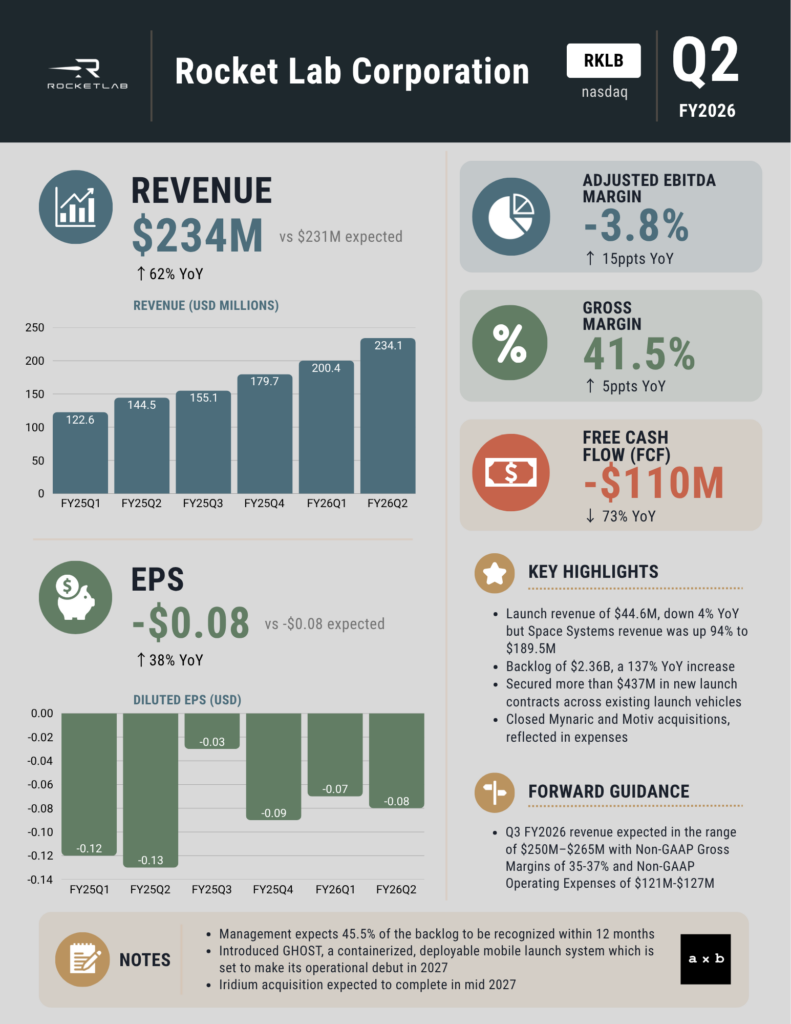

Rocket Lab Corporation (NASDAQ:RKLB) delivered a strong second quarter, with revenue climbing 62% year over year to $234.1 million, beating consensus estimates. Growth was driven almost entirely by Space Systems, which nearly doubled year over year to $189.5 million and now makes up roughly 81% of revenue. Launch, by contrast, fell to $44.6 million, down from $46.6 million a year ago and down sharply from $63.7 million last quarter. Management points to strong launch backlog and $437 million in new launch contracts as evidence this is a timing issue, not weaker demand. The net loss narrowed to $49.3 million, or $0.08 per share. Total backlog reached a record $2.36 billion, up 137% year over year, reflecting sustained demand across the business.
Looking ahead, management guided for Q3 2026 revenue of $250 million to $265 million, which would mark another sequential record. The company remains unprofitable, and management has not given a firm timeline for reaching net profitability, though longer-term targets call for gross margins above 50% and operating margins in the mid-to-upper 20% range as Neutron and Electron scale.
The most significant near-term catalyst remains Neutron, targeting a maiden flight in Q4 2026, which has already secured meaningful commercial and national security backlog, including U.S. Space Force awards, ahead of its first launch. Neutron is positioned to compete directly with SpaceX’s Falcon 9, meaningfully expanding Rocket Lab’s addressable market into large constellation deployment and higher-margin government missions. The company is also developing GHOST, a containerized launch system for rapid, tactical military deployments.
Beyond launch, Rocket Lab is increasingly building out a full-stack space solutions business, spanning launch, satellite manufacturing, components, and on-orbit services, which reduces reliance on any single revenue stream. Its move to acquire Iridium, a major satellite communications provider, in an approximately $8 billion deal underscores this strategy, potentially giving Rocket Lab a foothold in owned and operated satellite constellations and recurring service revenue rather than just hardware and launch. The company is also expanding internationally, establishing Rocket Lab Germany GmbH to pursue European defense and commercial satellite demand as EU and NATO members push toward sovereign space capabilities.
Here is the high-level summary card covering key figures and guidance.