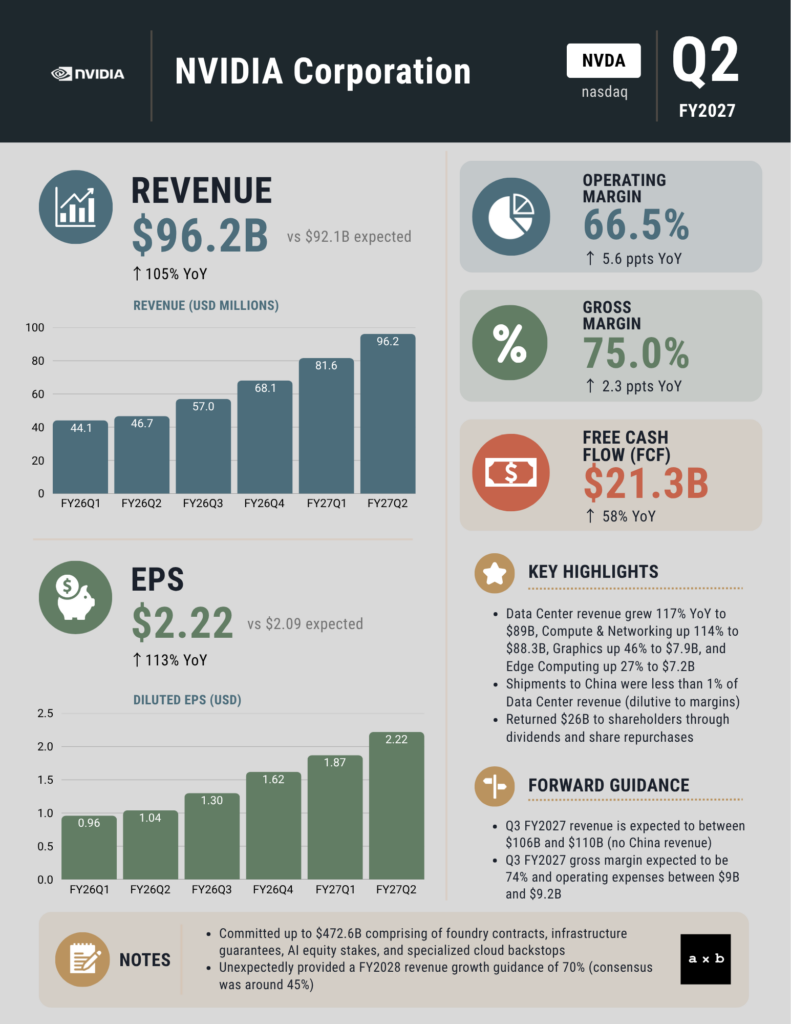

NVIDIA Corporation (NASDAQ:NVDA) delivered a record second quarter for fiscal 2027, with revenue more than doubling year over year to $96.2 billion, up 106% and well ahead of the $92.1 billion consensus. Data Center revenue rose 117% to $89 billion and now makes up roughly 93% of the business, driven by the ramp of the Vera Rubin platform at partners like CoreWeave, Google Cloud, and Microsoft Azure. GAAP net income was $59.7 billion, or $2.46 per diluted share, while non-GAAP EPS of $2.22 beat estimates of roughly $2.09. Gross margin held at 75%, and Nvidia returned $26 billion to shareholders via buybacks and dividends.
Management guided fiscal Q3 revenue to $108 billion, plus or minus 2% (roughly $106 billion to $110 billion) setting up another sequential record despite continuing to assume no China Data Center compute revenue. Gross margin is expected to slip to 74% in Q3 and further to 71%-72% in Q4 on rising memory costs tied to the broader AI buildout, before stabilizing in fiscal 2028. Notably, management also offered a preliminary fiscal 2028 revenue growth outlook of roughly 70%. This is unusual this early in the cycle, framing it as a supply constrained rather than demand constrained number, with confidence coming from improved supplier visibility and the fact that NVIDIA itself is now funding and locking in many of the projects driving that demand.
That point highlights a bigger strategic shift where NVIDIA is moving far beyond just selling chips. It is now actively funding and building out the entire AI ecosystem to make sure the capacity exists and customers can actually use its platform. Instead of relying on one off hardware sales, NVIDIA is pulling three main levers at once. First, it is securing the supply chain and infrastructure through massive commitments to memory, data center leases, and land and power guarantees for key partners. Second, it is directly investing in model makers and neoclouds to expand compute access while capturing a slice of their downstream revenue. Third, it is partnering with major private equity institutions to unlock over $500 billion in external capital.
NVIDIA is positioning itself to finance, build, and monetize the very infrastructure its business depends on. That goes a step beyond traditional circular financing, as it is actively de-risking the physical supply chain and taking a ongoing cut of the software and service layer.
Here is the high-level summary card covering key figures and guidance.